CHAPTER IV
The History
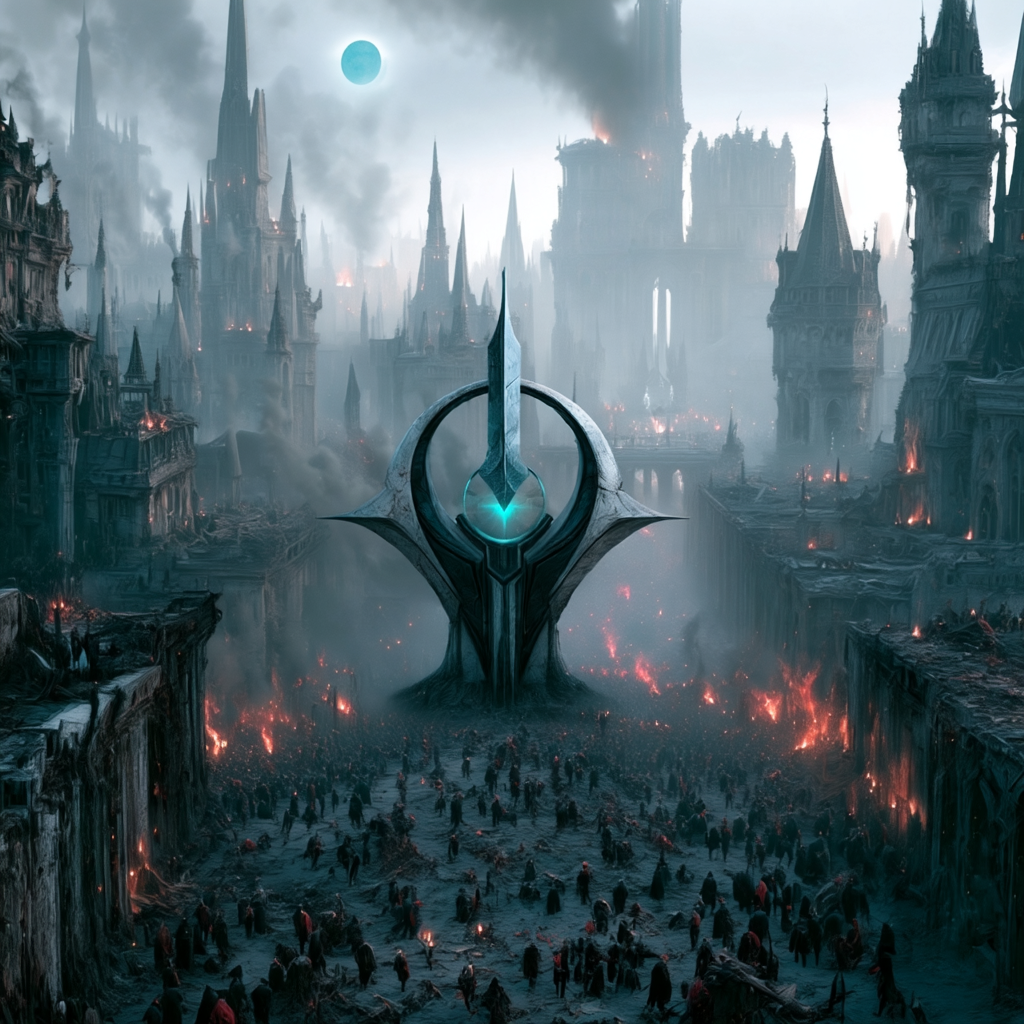
Two centuries before the rebellion, the landscape of Arcasia looked different. It was organized around 7 factions with their own culture. When the Demorcs crossed the northern frontier with black banners and the symbol of the Red Sun, the factions were unprepared. In three years of war, the Seven Factions of Arcasia fell one by one — and from their ashes, a single people emerged in the Southern region.
Year One · The Red Sun Rises
The Invasion Begins
For generations, the northern mountains had protected Arcasia from the hostile lands beyond its borders. The Aethari considered these mountains a natural barrier, while Ciiroa maintained the great southern passage connecting the north with the rest of the continent.
When the first Demorc armies appeared beyond the northern frontier, the Aethari believed they faced another incursion by weak hostile tribes. They sent diplomats to negotiate with gifts, proposed trade agreements, and offered peaceful coexistence. None returned.
Soon afterward, thousands of Demorc warriors crossed the northern frontier. They marched beneath black banners bearing the symbol of the Red Sun. The invasion had begun.
Year One · The North
The Fall of Aethari
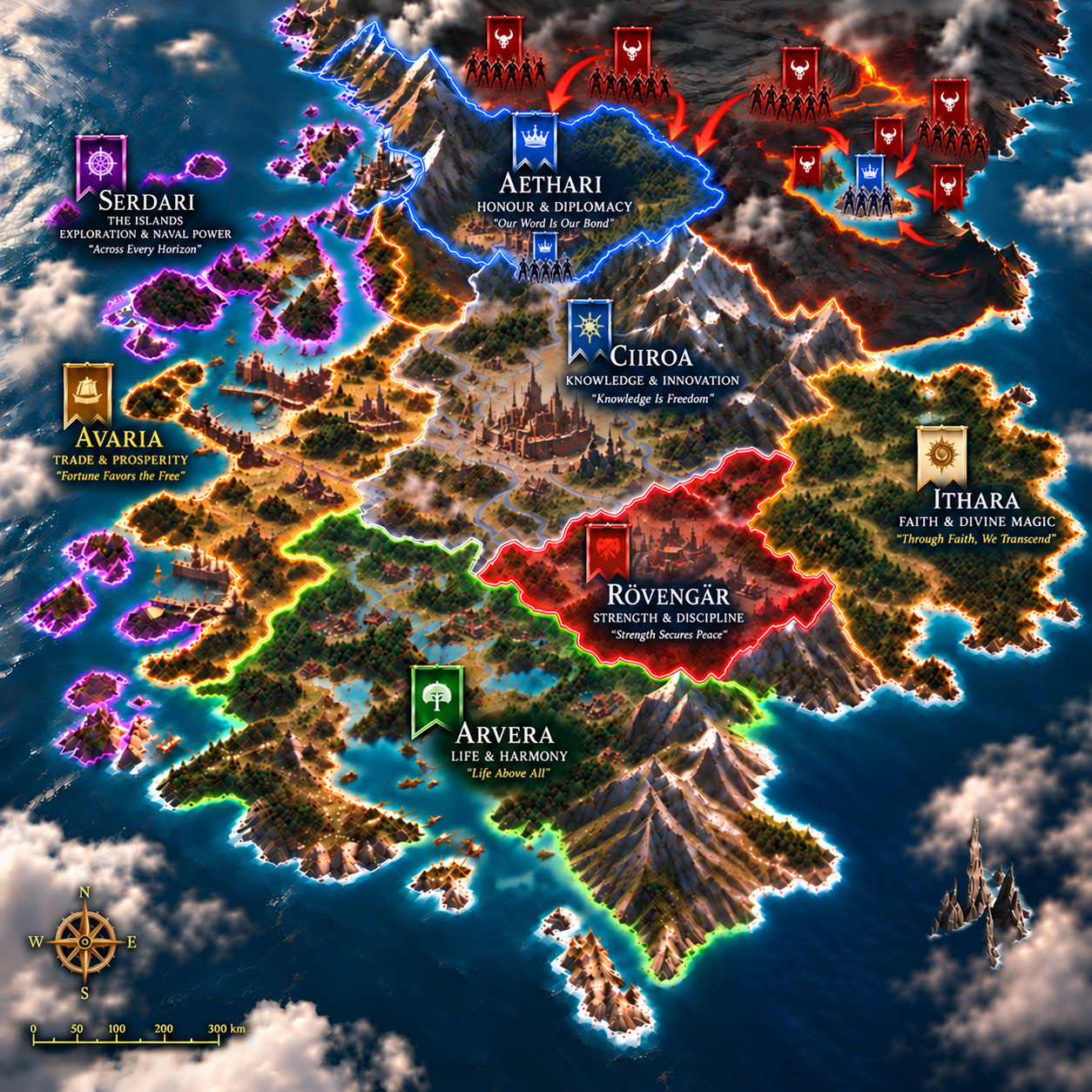
The Aethari mobilized their armies and established defensive positions throughout the northern mountain valleys. Their soldiers were disciplined, well-equipped, and experienced in defending narrow passages. The first Demorc assaults were repelled — but the invaders continued to advance, sacrificing enormous numbers of warriors to overwhelm the defenders.
When the Aethari realized this movement was bigger than anything they had ever seen, they requested support from Ciiroa and Rövengär. Ciiroa agreed to send engineers and supplies. Rövengär offered military assistance, but demanded unified command of the northern armies under their leadership. The Aethari refused, and the dispute delayed Rövengär's support disastrously.
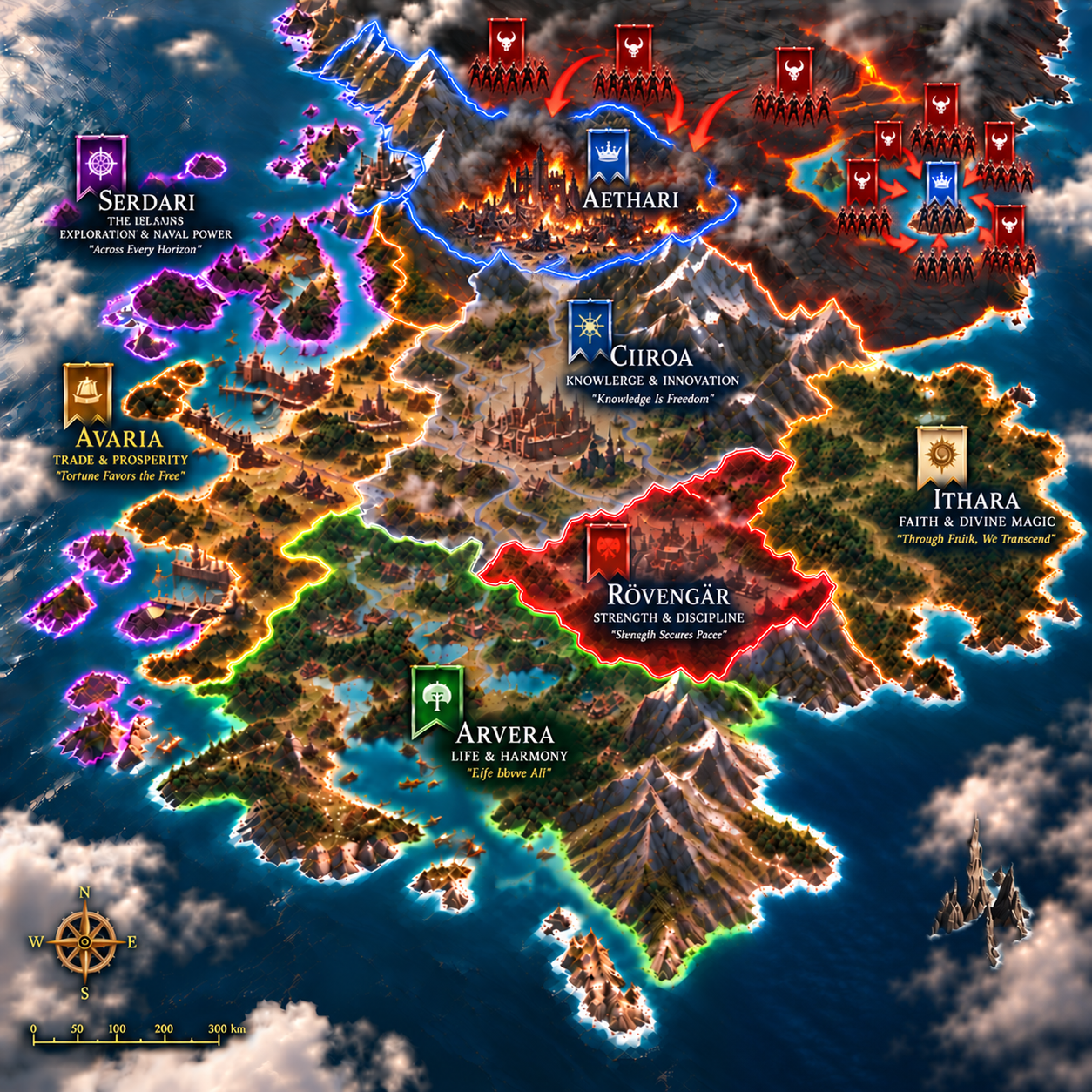
After weeks of fighting, the Demorcs broke through the outer defenses. The surviving Aethari forces retreated toward their fortified island city off the northeastern lake, believing the surrounding waters would protect them. But the Demorcs left a small army to surround the eastern city, then continued south and assaulted the capital, as the Aethari army was now split in two. While Aethari hoped for reinforcements, the southern factions prepared their own defences and gave up on their northern neighbour. The Demorcs broke through the capital, enslaved the survivors, and starved out the second army in the fortified city in the east.
Stories still spread in current Arca that when the capital fell, the survivors in the north-eastern city tried to reach it. Every attempt to break through the Demorc army failed, as volleys of arrows struck them on the bridges toward the mainland. After two attempts, the bridges were no longer visible, due to the dead bodies of those who desperately tried to return to their capital.
The first of the Seven Factions had fallen.
Year Two · 199 Years Before the Rebellion
The Breaking of Ciiroa
The Demorcs now controlled the northern territories, but one obstacle remained between them and the heart of Arcasia: the great mountain passage guarded by Ciiroa.
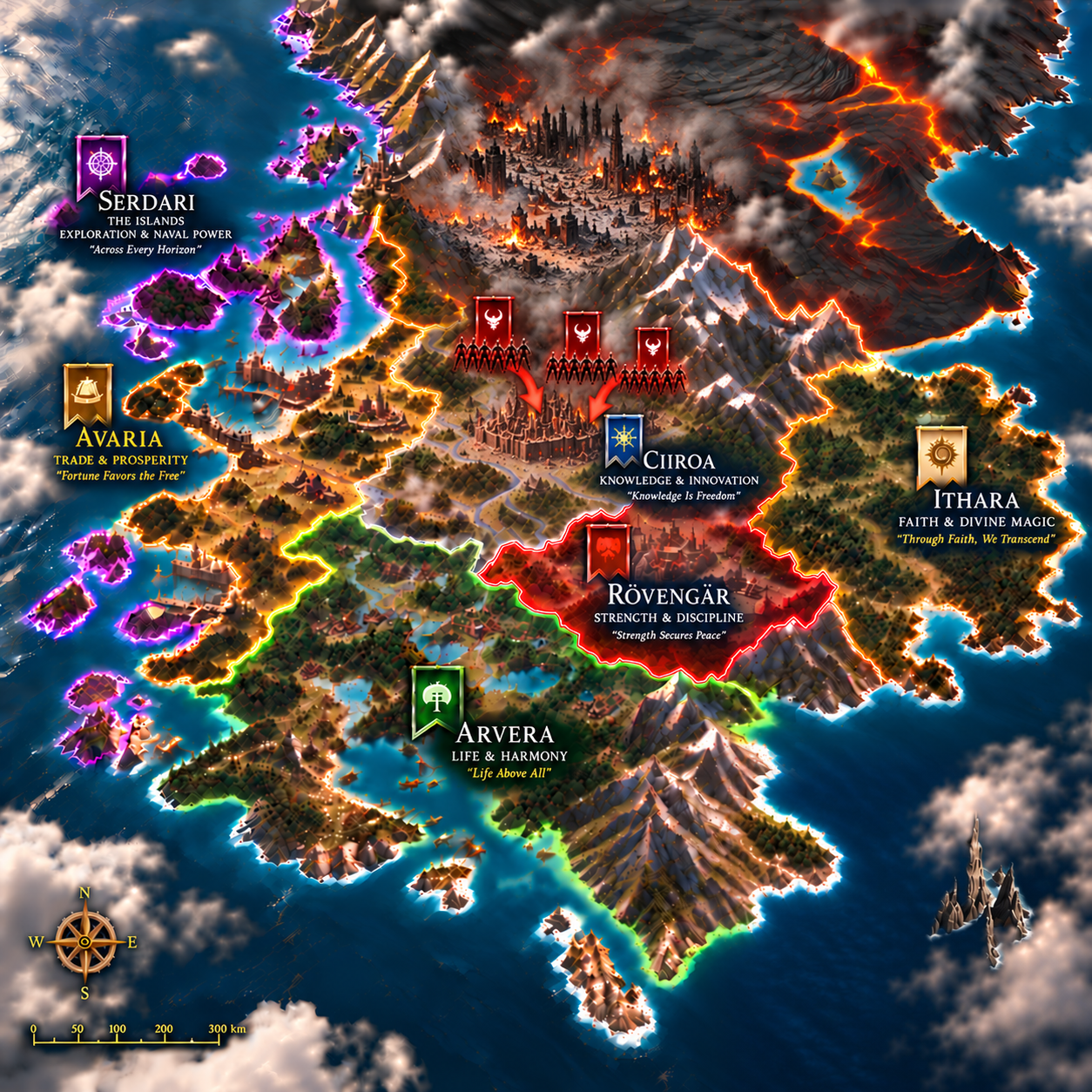
The Ciiroans had anticipated the possibility of a northern invasion for centuries. Their engineers had constructed an elaborate defensive system through the mountains: fortified walls, narrow roads, watchtowers, and defensive machines. They only needed trained fighters, which they did not possess. When Ciiroa asked Rövengär for military assistance, Rövengär again requested a unified army under their leadership. Ciiroa accepted — until disputes erupted over the battle strategy. Ciiroa planned to defend their city from within, whereas Rövengär proposed retreating all humans to their own fortress, which was the most fortified position in existence, and cutting the Demorc army off from the northern lands should it move westwards. Abandoning the city's accumulated knowledge was unacceptable for Ciiroa. A compromise was made then, in which Rövengär sent a few elite units, a quarter of its army to defend the city.
The combined Ciiroan and Rövengärian army inflicted major losses on the Demorcs with sophisticated siege machinery. All seemed to go in humanity's favour until a red sun rose above the Demorcs. Moments later, huge red stones and ballistic spears flew over their ranks and struck the city walls. The barrage continued until the majority of the walls were breached, and the assault began.
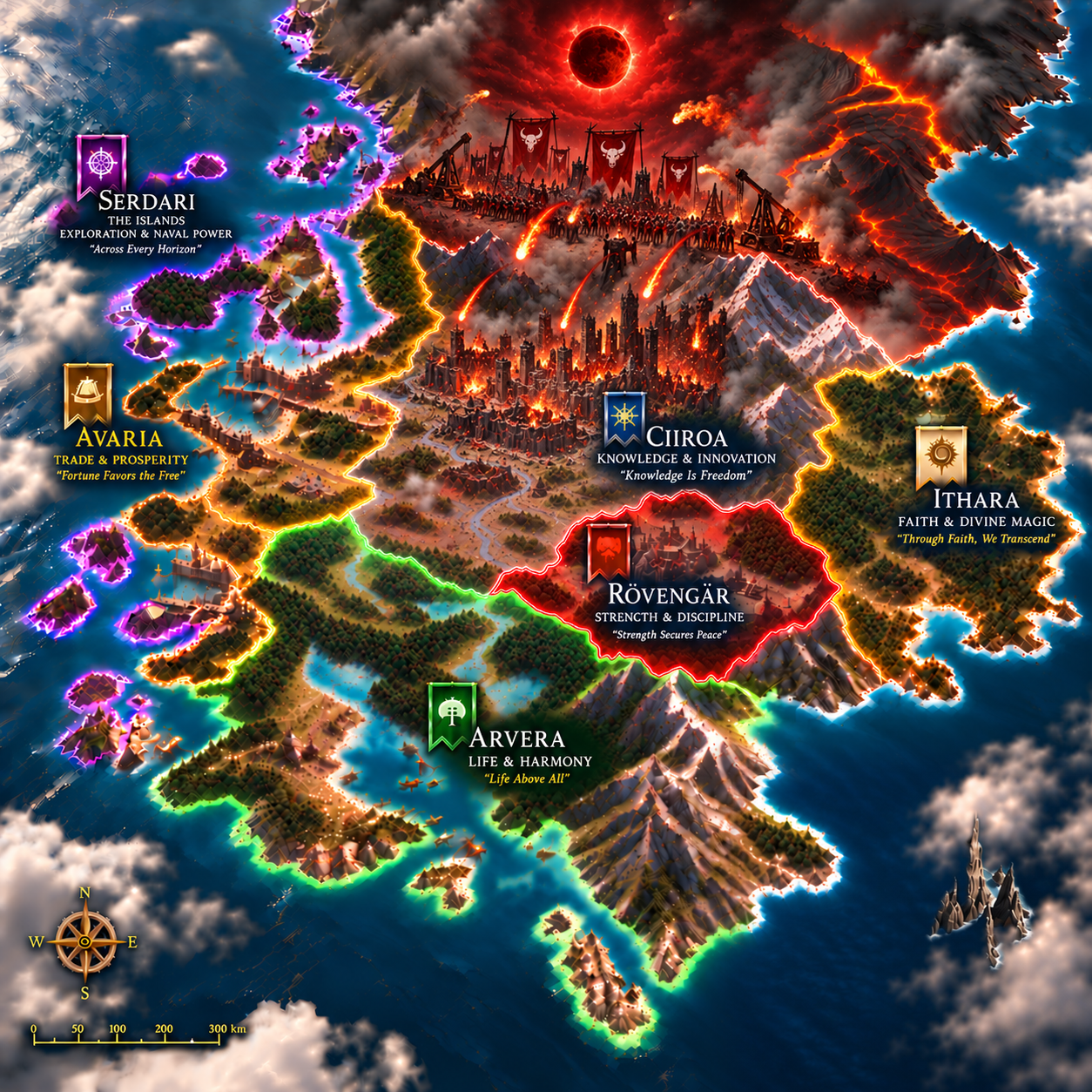
Once the Demorcian army was inside, the humans did not stand a chance. The city was never built to resist an assault. It devastated the capital, its academies burned, and countless manuscripts were lost. Ciiroa's scholars attempted to evacuate their most important discoveries, but much of their accumulated knowledge disappeared. The intellectual soul of Arcasia was destroyed.
Year Two · The West
The Collapse of the Western Coast
With Ciiroa defeated, the Demorcs divided their forces. Their main army advanced south toward Rövengär, while a secondary force marched west toward Avaria's wealthy coastal settlements.
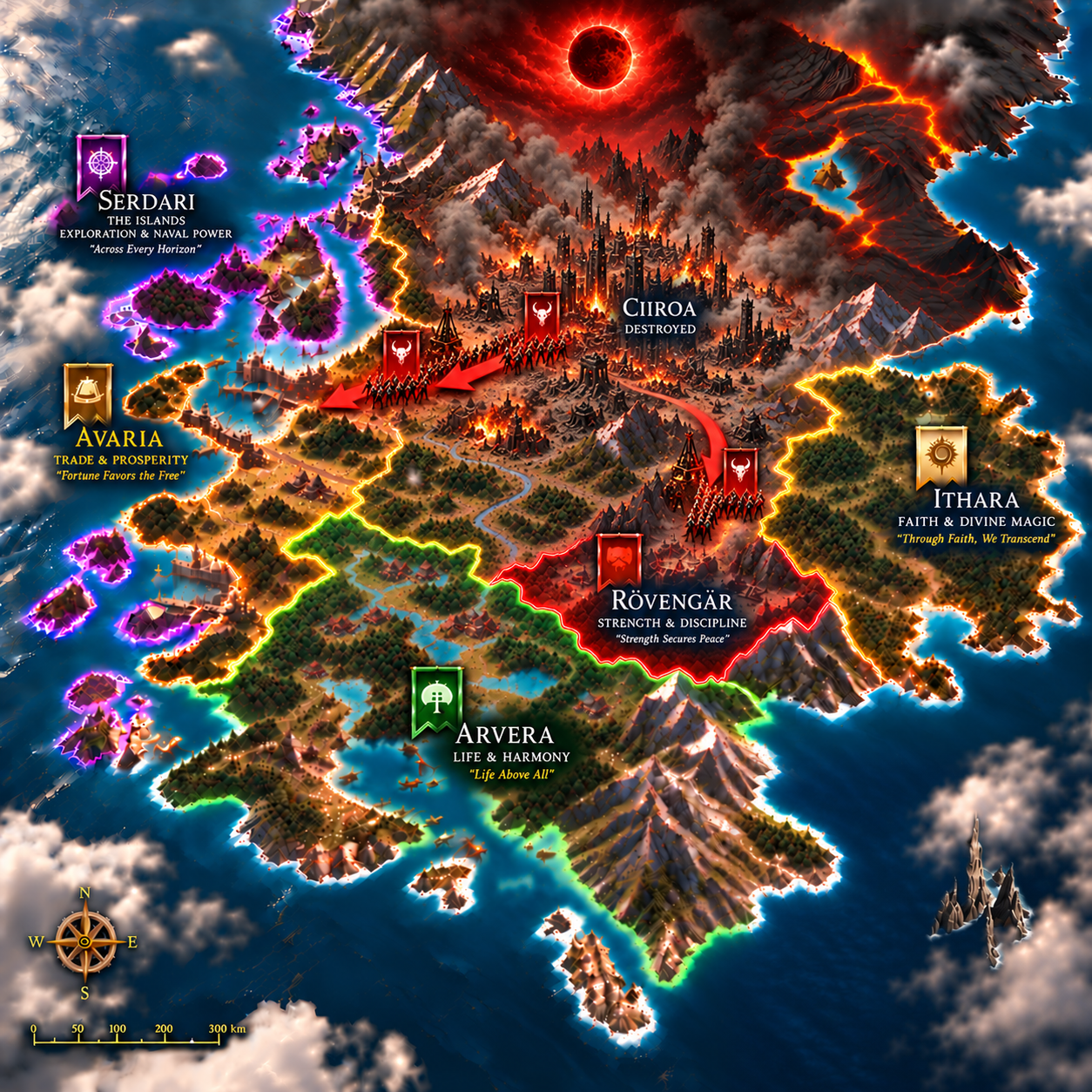
The Avarian merchant families initially attempted to negotiate, offering tribute, slaves, and supplies in exchange for political independence. The Demorcs rejected the arrangement and seized the western ports. Avaria's military was weak and small, as "war" had never been a part of their culture. Individual merchant families tried to hire soldiers from Serdari to protect their own property, but a unified army was never established.
Within months, its major commercial centers had fallen and the majority of the population was enslaved. A small minority escaped by ship to Serdari and their islands.
Year Two · The Islands
The Serdari Decision
Across the sea, the Serdari watched the mainland collapse. Their captains refused requests to join the war, considering the conflict a struggle between mainland rulers, none of whom had ever respected Serdari independence. Some Serdari ships rescued refugees from Avaria.
The Demorcs never launched a major invasion of the distant islands during the three-year conquest, as their priority remained the destruction of organized resistance on the mainland. The Serdari preserved their independence, but their refusal to intervene would haunt their relations with the other clans for generations.
Year Two · The East
The Silencing of Ithara
The eastern region of Ithara was home to religious communities devoted to the Blue Sun. Unlike the other factions, Ithara possessed no great cities or conventional army. Its people lived in scattered sanctuaries, forest settlements, and isolated mountain communities.
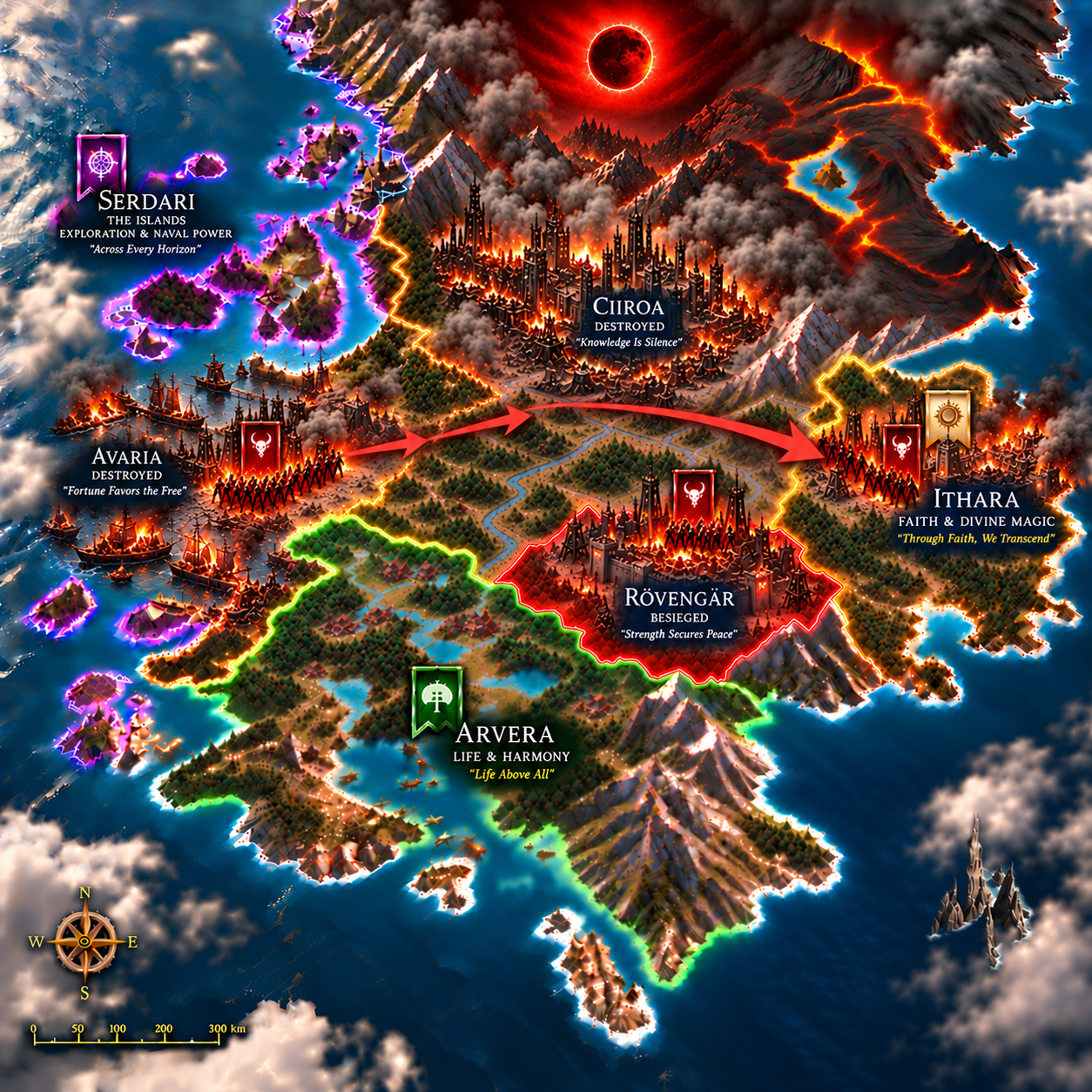
When Demorc forces approached from the west, Itharan priests attempted to protect their lands through powerful magical rituals. Several enemy detachments were repelled by magical barriers and the concentrated divine energy of Löras. But Ithara's communities lacked the military organization to resist a sustained invasion, they strongly believed that Löras would protect them from any harm, and would never betray him, no matter the cost.
The Demorcs began targeting sacred sites and religious leaders. While the Itharans fought bravely back with magic, their sanctuaries were burned. No one survived the slaughter, and Ithara was utterly destroyed. By the end of the second year, nearly every major faction of northern and central Arcasia had collapsed. Only one great military stronghold remained.
Year Three · 198–197 Years Before the Rebellion
The Siege of Rövengär
Rövengär had spent centuries preparing for war. Their fortress, southeast of Ciiroa, was considered one of the strongest defensive positions in Arcasia. Its high, thick walls were thought unbreakable, and the fort held three layers of walls inside. Even if the Demorcs broke through the first walls, they would have to fight through two more while vulnerable from multiple sides.
The Demorcs concentrated their siege engines against the eastern defenses. For weeks, enormous projectiles struck the walls without success, and repeated assaults were repelled as Ciiroan engineers operated the defensive machinery. The Demorcs eventually abandoned direct assaults and established a complete blockade. The siege became a war of endurance.
As the blockade continued, food supplies diminished. The fortress had been designed to withstand prolonged sieges, but the arrival of thousands of refugees from other factions placed unexpected pressure on its reserves. The fortress refused to surrender, believing it represented humanity's final hope. Tensions grew between the military leadership and the civilians, but the fortress remained united.
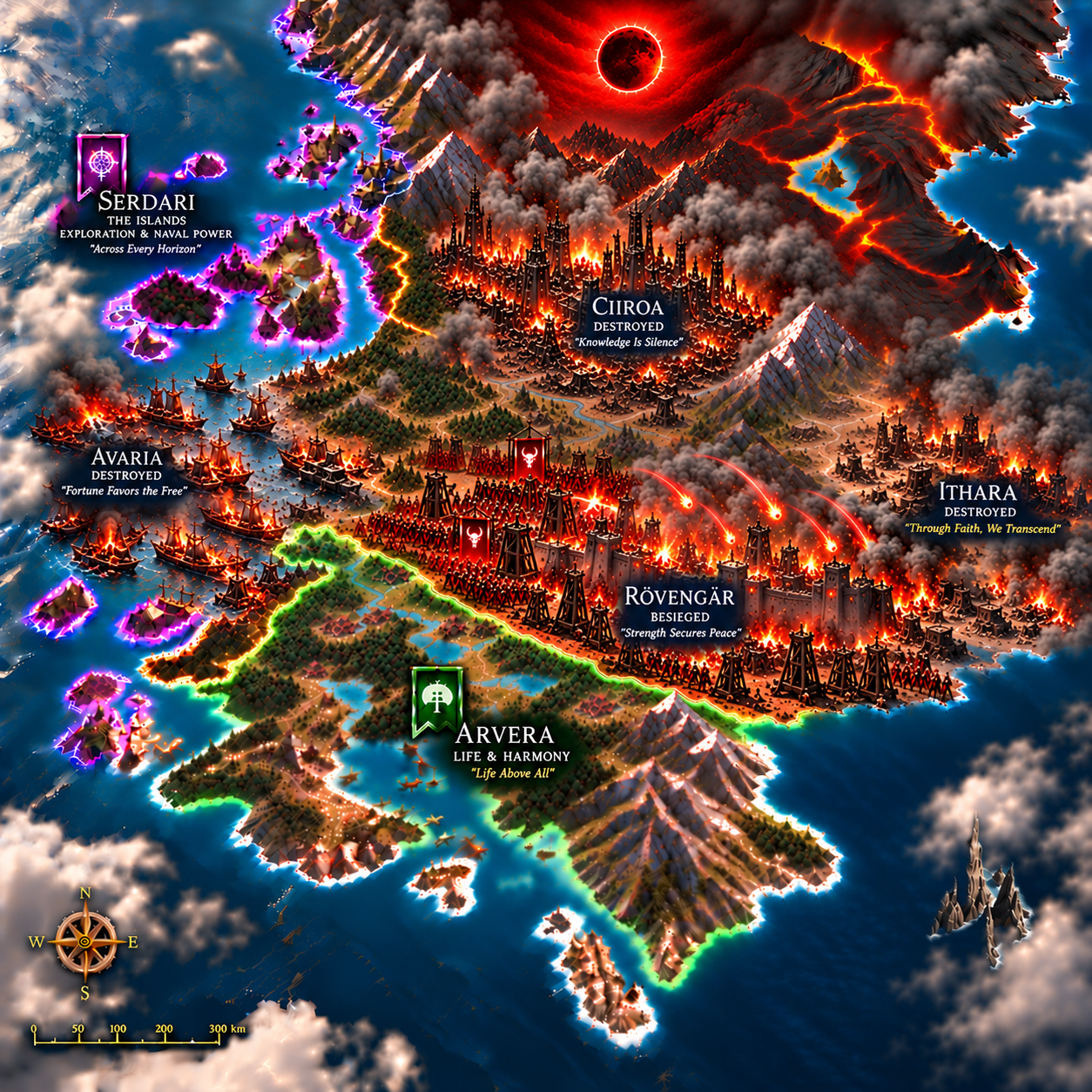
After nearly a year of siege, the Demorcs breached the inner defenses through the second wall. Only a fifth of Rövengär's original army remained. The remaining soldiers prepared for their final battle, for defeat meant enslavement. They fought beneath the banners of their walls together with what was left of the Aetharian and Ciiroan armies. The fortress fell, overwhelmed by Demorcs in a night that was bright red.
And as the defeat slowly took place, many wondered where the Blue Sun was, and why it did not protect them.
The End of the War
The Birth of the Arca
After three years of war, the organized resistance of the Arcasian factions had ended.
The Demorcs considered conquering the southern region after the fall of Rövengär, but never continued the assault southwards. Arvera contained no major cities, no significant military fortresses, and no great concentrations of wealth. Their population was scattered across forests, valleys, villages, and agricultural settlements. The Demorcs considered the south irrelevant, weak and primitive.
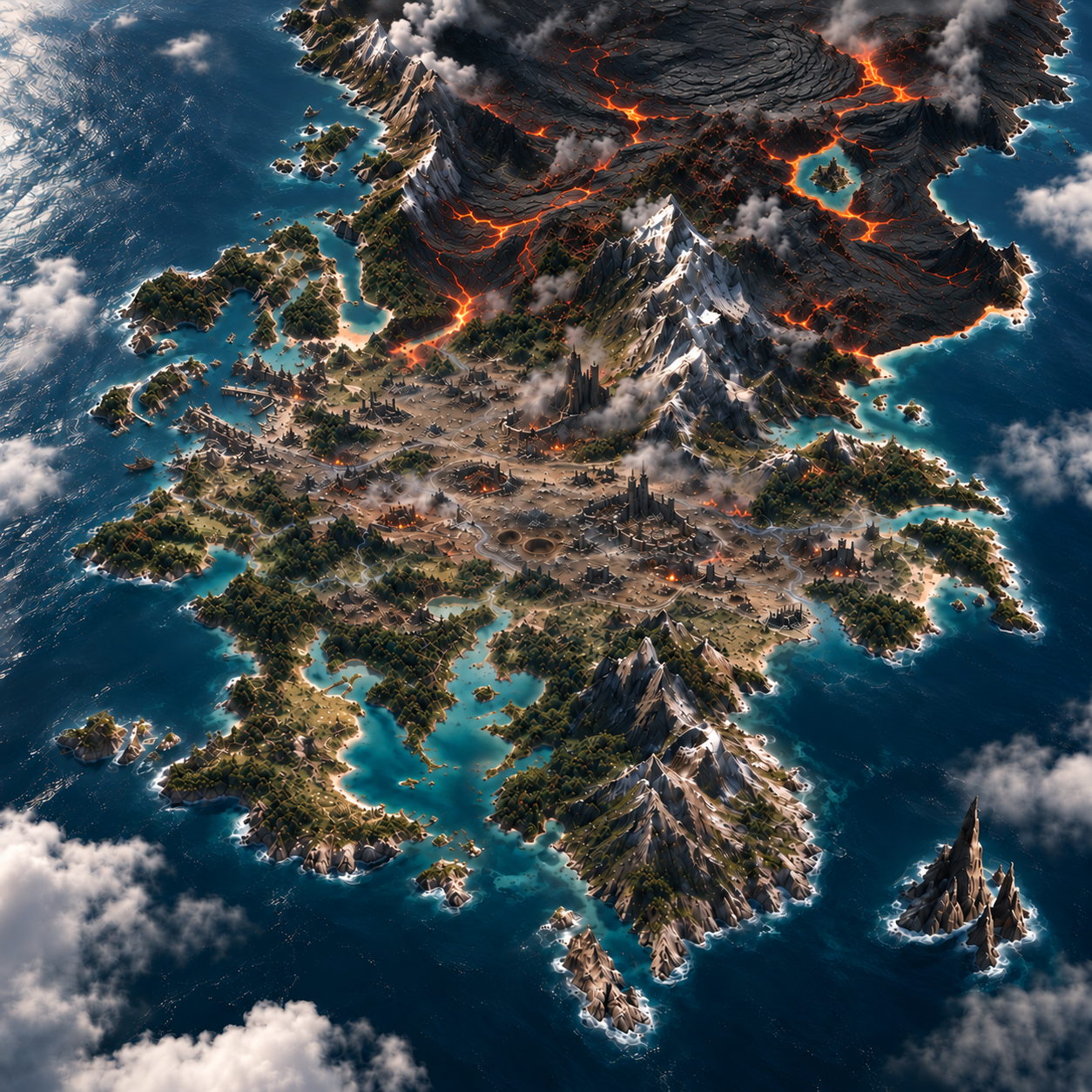
Thus, Arvera in the south became a sanctuary for survivors from all destroyed factions. Their communities welcomed refugees fleeing the conquered territories. Over generations, the surviving populations began to merge and their descendants increasingly saw themselves as part of a new single people: The Arca.